
Look after the court and it looks after you
Court Care
The Alta Padel maintenance program — what your team does, what we do, and how the two fit together across the service year.
How it starts
We service any padel court.
Not just ours. If you have courts on the ground — whoever built them — we can take on the maintenance. What differs is where we begin.
Courts we built
Court Care at a discount, when bought at handover. At the walkthrough on installation day, owners of new Alta courts can prepay one to five years of Court Care at a discounted rate. After that term, plans continue at the standard rate.
Full on-site training for your team comes with installation.
Courts built by others
We start with a Condition Assessment — a site visit, a full inspection against our schedule, and a written report on what the courts need and what shape they are in.
We do this before quoting a contract because we have no history on those courts: no record of how they were built, what has been done to them or what has been left. If you sign a contract at the visit, the assessment becomes the first service visit of that contract.
Where we work
Court supply and installation are nationwide. We ship and build across the United States from our base, and distance affects the schedule rather than whether we take the job.
Court Care is a different commitment. It runs on scheduled visits by our own crew, so the program is strongest across the Southwest and we are expanding outward from there. Tell us where your courts are and we will tell you plainly whether we can put a crew on them yet — and if we cannot, we will say so rather than sell you a contract we would struggle to keep.
- 1
A call, at no charge
Tell us how many courts you have, who built them, where they are and how hard they are used. We will tell you what cycle we think they need — on the call, not in a follow-up.
- 2
A written quote
A fixed annual figure for your site, your court count and your region — not a per-hour rate that moves. For courts we did not build, the Condition Assessment comes first and the contract quote follows it.
- 3
Visits scheduled for the year
On signature we book the whole year's visits into the calendar, timed around your season rather than ours.
Why a court builder runs a service company
Because we know what is underneath.
We specified the slab, the ring beam and the anchor schedule; we know the torque figures, the glass bedding and the infill depth the turf was designed around. When we inspect a court we are checking it against the standard it was built to, not guessing at one. On courts built by others we start with a condition assessment for exactly that reason — we will not price work on a court whose history we do not know.
A court is not finished when it is installed. That is when the clock starts.
Racket sports experience
Combined experience across design, manufacturing, installation and service.
Whoever built them
We service padel courts we did not supply, to the same schedule as our own.
At handover
Prepay 1–5 years of Court Care at handover, at a discount.
01 Why maintenance decides court life
Courts don't break. They drift.
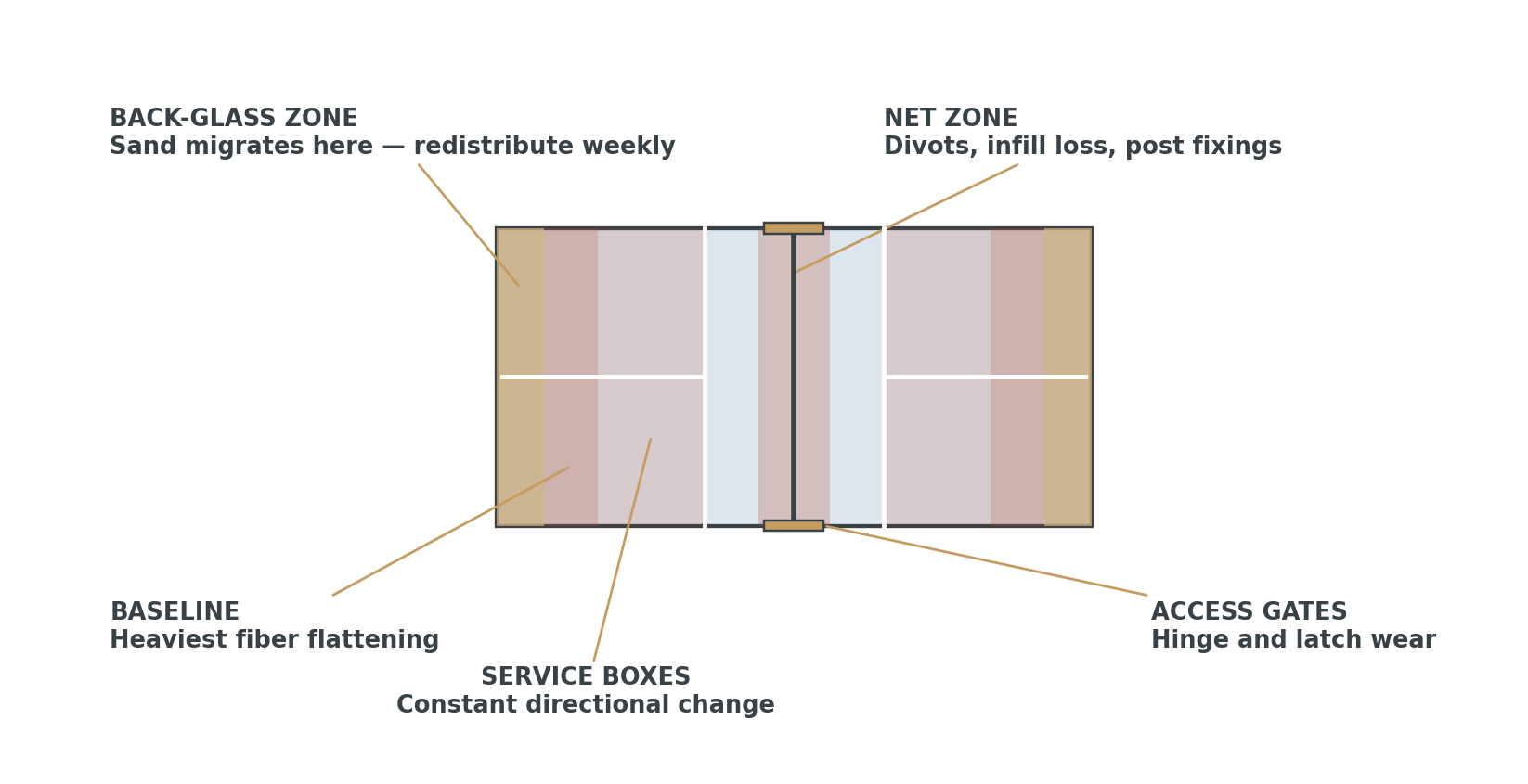
Nothing on a padel court fails on a Tuesday. The sand creeps toward the back glass a little further each week. The fibers lie down under the baseline. A bolt backs off a quarter turn every time a player hits the fence. None of it is visible on any single day, and all of it is obvious after a year.
The symptoms reach you through players first — a court that plays "fast," a corner that feels hard, a rattle off the glass. By then the cause is usually months old. Maintenance is the practice of catching those things while they are still adjustments rather than repairs.
What it costs to leave it
Compacted infill hardens the surface, which changes the bounce and puts the load through players' joints instead of the sand. Left long enough it ends in resurfacing rather than a top-up.
A chip at a glass edge concentrates stress and spreads under impact and temperature swing. Caught early it is a panel inspection. Caught late it is a panel.
A blocked drain puts standing water against the turf backing and, eventually, into the slab. That is the one that stops being a court problem and becomes a groundworks problem.
02 Who does what
Your routine, our visits.
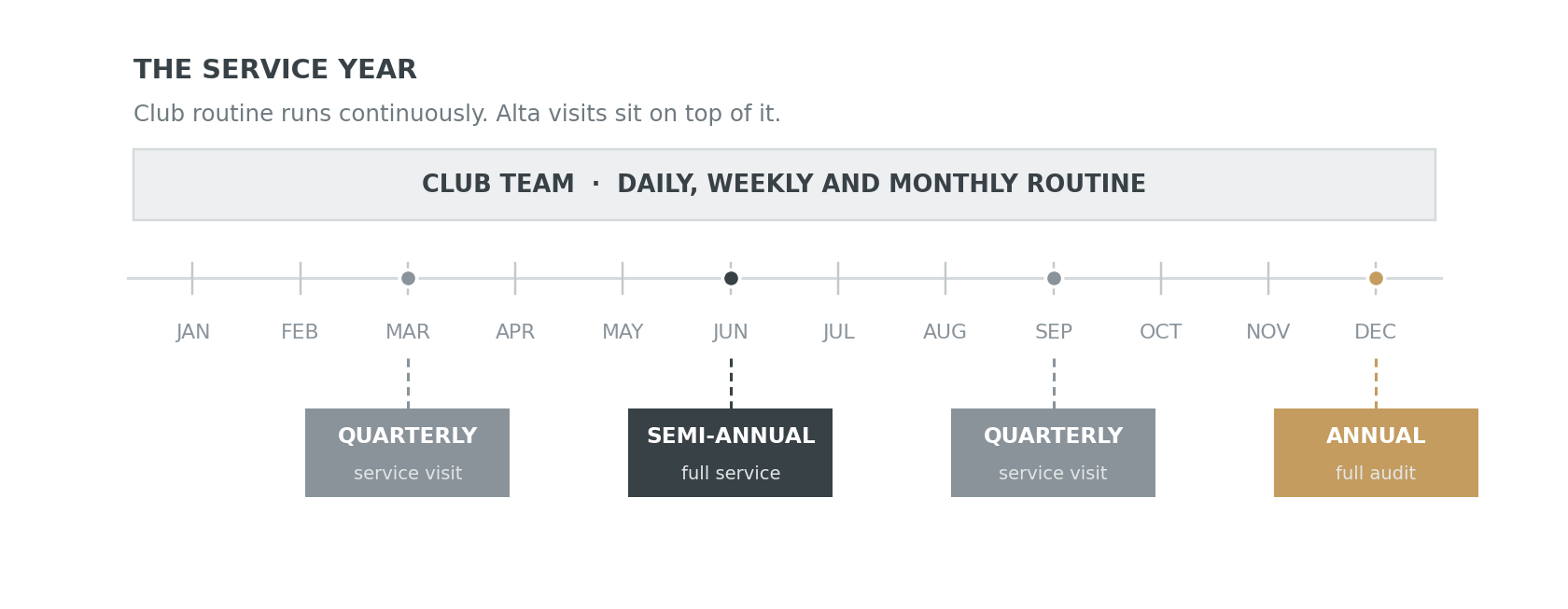
The day-to-day work belongs with your team — it is quick, constant, and nobody is better placed to do it. What we bring is the periodic work that needs equipment, torque figures and a trained eye, plus a second opinion on everything your team has been watching.
Carried out by
Your club team
Daily — 10 to 15 minutes
- Clear leaves, dust and loose debris
- Walk the baselines and net area for displaced sand
- Eye over the glass for chips and ball marks
- Check net height and tension
- Look for standing water after rain
Weekly
- Brush the turf in more than one direction
- Redistribute sand back from the glass and edges
- Clean glass with a neutral, non-abrasive product
- Check gate hinges and latches
- Inspect seams and line markings
Monthly
- Clear perimeter drains and channels
- Check visible bolts and fasteners
- Look for early rust at joints and bases
- Clean luminaire faces; confirm all are lit
- Log everything — dates, not memory
Carried out by
Alta Padel
Quarterly visit
- Mechanical brushing and sand redistribution
- Infill depth measured, not estimated, and topped up
- Torque check on structural fixings to specification
- Glass panel and seating inspection
- Drainage flow test and clear
- Written condition report
Semi-annual visit
- Everything in the quarterly visit
- Mechanical decompaction of the infill
- Anti-corrosion inspection and touch-in
- Net, post and anchor service
- Lighting output and alignment check
- Refresher session for new club staff
Annual audit
- Everything in the semi-annual visit
- Full structural and anchor survey
- Turf life assessment and forward plan
- Algae and moss treatment where needed
- Documented report for warranty and insurance
03 Service levels
Three cycles, same standard.
Every visit follows the same inspection, whatever the cycle. What changes is how much restorative work is done while we are there, and how far ahead we can see. Busier courts need shorter intervals — not a different service.
Quarterly suits high-traffic commercial clubs and tournament venues. Semi-annual is the standard program, and what every Alta Padel court carries in its first year. Annual suits lighter-use sites — private estates, resorts and seasonal facilities — where a club routine is already in place.
04 Discounted at handover
Court Care at a discount, when bought at handover.
At the walkthrough on installation day, owners of new Alta courts can prepay one to five years of Court Care at a discounted rate. After that term, plans continue at the standard rate.
At commissioning
A full on-site training session with your team: brushing technique, sand levels, what a correctly seated glass panel looks and sounds like, which fixings matter, and what to escalate. We leave a written routine behind.
On your chosen cycle
Quarterly, semi-annual or annual visits by our crew at the discounted rate. The first visit usually resets the sand after the bedding-in period every new court goes through.
Throughout
Phone and email support for your team on anything they find. If something sits outside normal wear, we come back and deal with it rather than leaving you to diagnose it.
Training is the point
Our visits matter, but your team touches the court every day. The training at handover is the part of this program that does the most work — and we will run it again for new staff at any semi-annual or annual visit, no charge.
Padel elevated
A court is only as good as its last service.
Tell us how many courts you have and how hard they are working, and we'll set the right service cycle against them.
Sales & projects
The full guide
The fourteen-page Court Care document carries the day-to-day reference this page summarizes: turf and sand infill, structure, glass and fixings, drainage, lighting and gates, your team's daily, weekly and monthly checklist, a troubleshooting table of what players report and what it means, and exactly what a visit does and does not cover. Request it from the document library (AP-SVC-2026).
Companion to the Technical & Spec Pack (AP-SPEC-2026) and the Groundworks Guideline (AP-GW-2026).