
Consulting & advisory services
From a site
to a club
Feasibility, engineering advisory, design, operations and launch — for investors, developers, landowners and operators building padel in the United States.
One thing said up front
Alta Padel builds courts. That makes us useful — we know what a site costs to build on before anyone draws it — and it means our advice comes from somewhere. How we work says so plainly, and sets out how we handle it.
Advice from people who build
Why this exists.
The advisory work exists because we kept being asked the same questions — how many courts, what will the ground cost, will anyone come — by people who had nobody impartial to ask.
Build cost is the number most feasibility studies get wrong, because the people writing them are estimating. Ours comes from work we have priced. The same is true of what a court needs from a building, what a lighting design has to hit, and how long installation takes — we are not interpreting someone else's specification.
We build courts. That is what makes the advice worth having — and it is why we say so on every page of it.
Racket sports experience
Combined experience across design, manufacturing, distribution and club development.
Not estimates
Build cost drawn from courts we have quoted and slabs we have specified.
Stop whenever you want
Five stages, each with a written deliverable and a decision at the end.
01 Who we work with
Different questions, same project.
Padel in the United States is roughly where it was in Europe fifteen years ago. Demand is arriving faster than courts, most markets are undersupplied, and almost everyone building is building their first one. The questions we get asked depend entirely on who is asking.
Investors
"Is this a business or a hobby?"
You want the demand case tested by someone who has no reason to flatter it, a court count that matches the catchment rather than the land, and a model that survives contact with a slow first winter. We build the case and show you where it breaks.
Developers
"What does padel need from my site?"
You are fitting courts into a wider scheme — residential, mixed-use, hospitality — and need the envelope, the clearances, the loads and the parking demand before the masterplan sets. Early is cheap here. Late is not.
Landowners
"Can I do something with this ground?"
You have land — a spare corner of a resort, a disused tennis facility, a parking deck, a field behind a hotel — and want to know what it could hold, what it would take, and whether anyone would come. That is a short piece of work and it answers a big question.
Operators & clubs
"How do I make this work harder?"
You are running courts already — a racket club adding padel, a gym converting space, a padel club that filled faster than expected. The questions move to utilization, programming, pricing structure and when to add the next court.
The mistake we see most
Court count decided by how much land is available rather than by how much demand exists. Too few courts and the club cannot run a league, a lesson program and open play at the same time — which is where the revenue is. Too many and the off-peak hours sit empty and the whole thing looks like a failure when it is only mis-sized. It is the cheapest decision to get right and one of the most expensive to correct.
02 How an engagement runs
Five stages, and a gate at each one.
Each stage answers one question and ends in a decision. You can stop after any of them, and plenty of projects should. Stopping at stage one having learned the site does not work is a good outcome — it is the cheapest possible version of finding out.
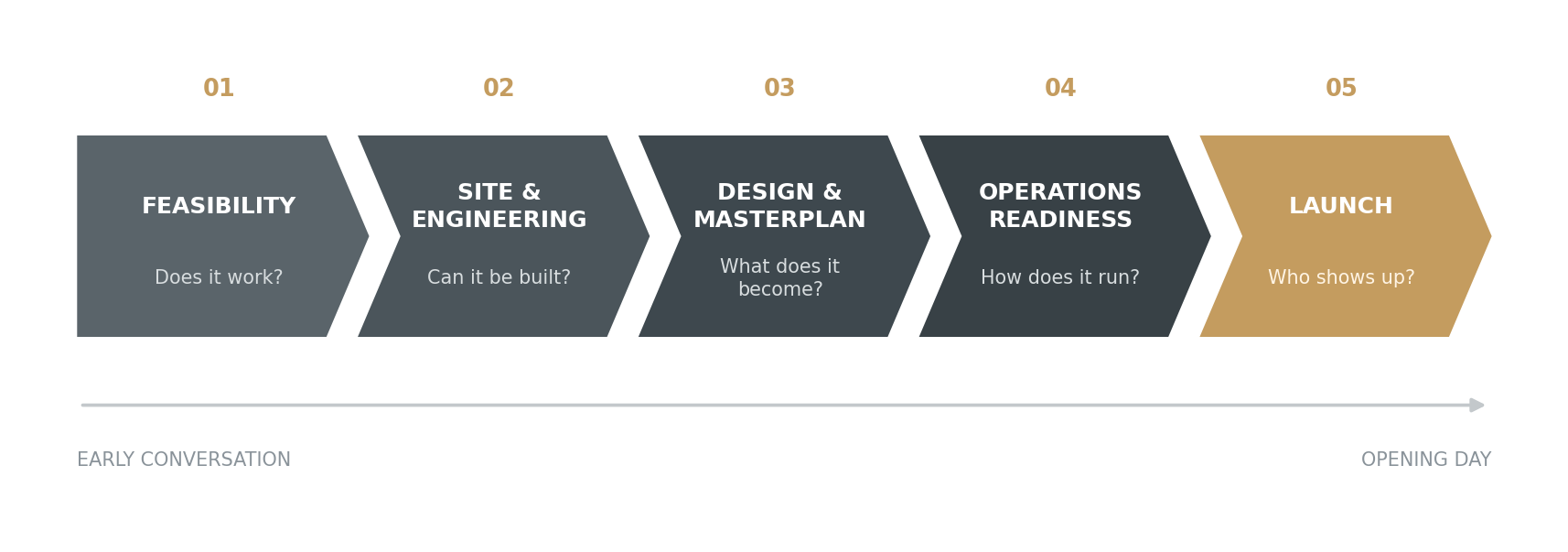
| Stage | The question | Decision |
|---|---|---|
| 01 Feasibility | Does the demand exist and do the numbers hold? | Proceed, resize or stop |
| 02 Site & engineering | Can it actually be built here? | Site confirmed |
| 03 Design | What should it be? | Scheme frozen |
| 04 Operations | How will it run and pay? | Plan adopted |
| 05 Launch | Who shows up, and do they come back? | Handover to operations |
You do not have to start at stage one. Some clients arrive with feasibility already done and want stages two and three; others have a building and a budget and need the operating plan. We pick up where the project is.
Two documents go to the project team
Our Groundworks Guideline (AP-GW-2026) sets the slab, ring beam, tolerances, drainage and electrical rough-in your contractor will build to. The Technical & Spec Pack (AP-SPEC-2026) gives your design team the court itself — structure, glass, turf, lighting and factory drawings. Both go to the project team at the start of the site stage, not at the end.
08 Existing clubs
Sites already running.
Not every engagement starts with bare ground. A good share of our advisory work is on facilities that already exist and need to work harder, grow, or add padel to something else.
Performance review
For clubs open twelve months or more and unsure why the numbers look the way they do.
- Utilization mapped by hour and day
- Pricing and allocation reviewed
- Programming gaps identified
- Court condition assessed
- Findings with a short action list
Expansion
For clubs at capacity in prime hours and deciding whether to add courts.
- Is peak demand real or a booking-policy artifact?
- Site capacity and what it can still hold
- Cover or enclose versus add outdoor
- Construction phased around a live club
- Model for the courts being added
Conversion
For tennis clubs, gyms, resorts and parking decks adding padel to an existing operation.
- What the existing surface can carry
- Courts gained per tennis court replaced
- Effect on the existing membership
- Shared staffing and systems
- Sequencing to limit downtime
Converting tennis courts
The most common conversion question in the US right now. Two tennis courts will generally take three padel courts; one tennis court takes one, with space left for viewing and circulation. On a sound concrete tennis slab the court can usually be anchored directly to what is already there — no saw-cutting and no ring beam — which changes the capital case substantially. Thickness, condition, planarity and fall decide it, and that is a site visit rather than a phone call. Our Tennis to Padel Conversion document (AP-CONV-2026) works it through.
10 How we work
Where the advice comes from.
We build padel courts. That is worth stating plainly in a document offering advice about whether to build padel courts.
What we do about the obvious
Consulting is engaged and paid for separately from any court supply. A feasibility study that recommends not proceeding is a completed engagement, not a failed sale.
We will tell you where a competitor's product is a better fit for a site, and we would rather do that at stage two than have you find out at handover.
Everything we produce is yours to take elsewhere. If you go to tender for courts at the end of it, that is a normal outcome and we expect to compete on merit.
Your documents are yours
Everything we produce belongs to you, including the financial model with its assumptions visible and editable. If you take the project to another supplier, the work goes with you. We would rather earn the court order on the courts.
What we don't do
- Stamp structural, civil or MEP drawings — that stays with your engineer of record
- Act as general contractor or construction manager
- Provide legal, tax, planning or investment advice
- Operate clubs on your behalf
- Guarantee a financial outcome from a model
Start with a conversation
Most projects start with a call and a look at a map. Tell us where the site is, what you are thinking of doing with it, and where the project is now. We will tell you what we think and whether we are the right people for it — both of which are free.
Padel elevated
Tell us about the site.
Where it is, what you are thinking, and how far along you are. A first conversation costs nothing and usually saves something.
Sales & projects
The full document
The fourteen-page Club Development & Consulting document works through each of the five stages in detail — what feasibility examines and how the model is built, what the site and engineering review covers, court layout and masterplanning, the operating and commercial plan, and the launch program — plus the written deliverable you receive at the end of every stage. Request it from the document library (AP-CON-2026).
Companion to the Technical & Spec Pack (AP-SPEC-2026), Groundworks Guideline (AP-GW-2026) and Court Care (AP-SVC-2026).