
Order to opening day
Installation
& Timeline
What happens between a signed order and the first rally — who does what, when, and what has to be true before our crew arrives.
Durations here are typical, not contractual
Manufacturing and shipping times vary with order size, specification and season. Your quote carries the dates that apply to your project, and those are the ones that govern. What does not vary is the sequence.
01 The whole timeline
Two jobs running in parallel.
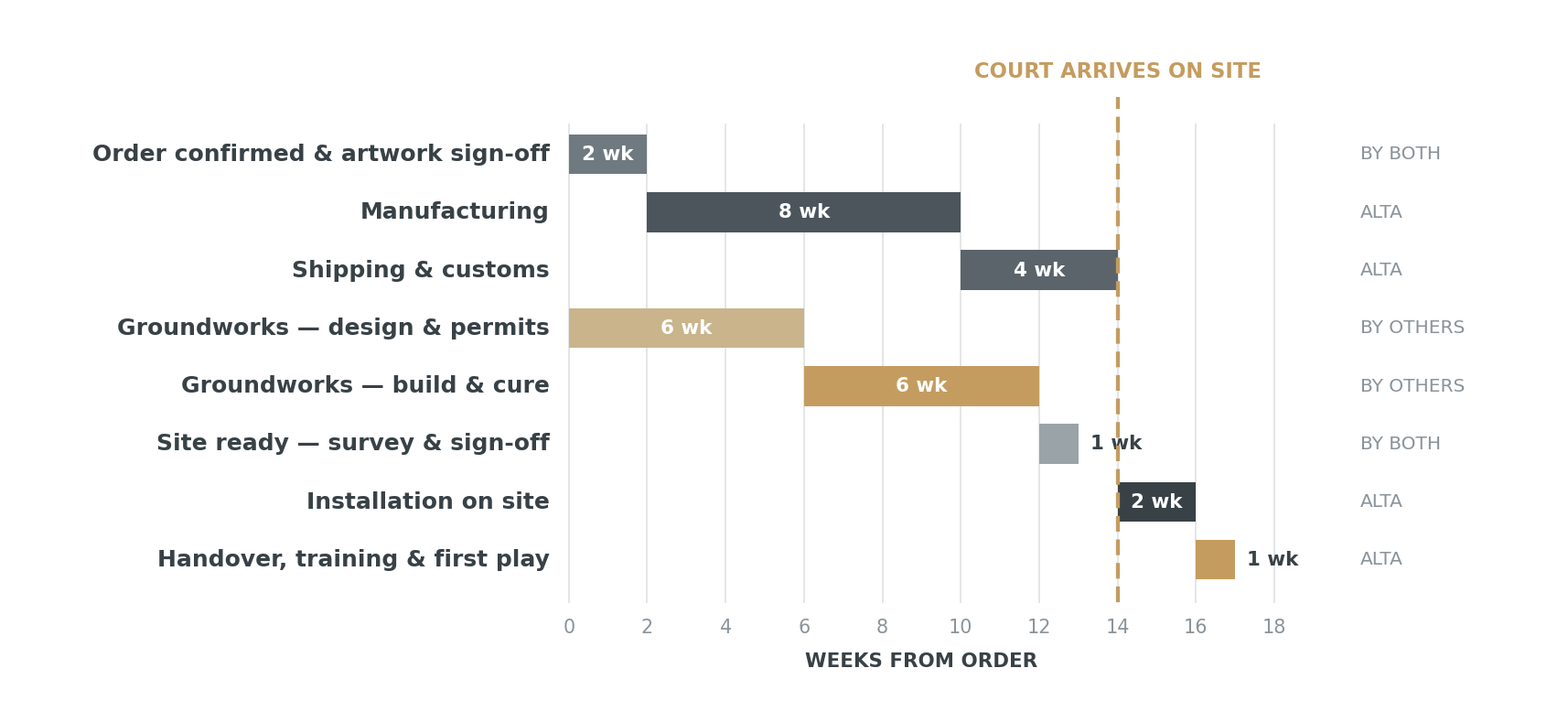
A padel project is two projects at once. We are building a court; someone else is building the ground it stands on. Neither one is the critical path on its own — the critical path is whichever of them finishes last.
What this shows
Manufacturing runs eight weeks and shipping four, so the court is on site roughly three months after a confirmed order. Groundworks — design, permits, build and cure — takes a similar span, and it starts from nothing while the court is already in production.
That overlap is the whole point. Start groundworks design when you place the order and the two finish together — the slab cures while the court is at sea. Start it when the court ships and you will have a container sitting in a yard.
The single most useful thing on this page
Groundworks design and permitting begins on day one, not when the court arrives. Permits in particular have no relationship to our lead time and no amount of expediting on our side will recover a permit that was applied for late.
Multi-court sites do not multiply the timeline. Manufacturing scales, shipping consolidates, and installation adds days rather than weeks. A four-court project is typically only two to three weeks longer end to end than a single court.
04 Site readiness
What has to be true before we mobilize.
Our crew travels to site with everything needed to build a court and nothing needed to fix a slab. These are the conditions that have to be met, confirmed in writing, before installation is booked.
The slab
Poured, cured and at design strength, square and level within tolerance, falling in one direction, not ponding, and swept clear of stored material — with the survey results sent to us and accepted before the date is booked.
The numbers we measure against are in the Groundworks Guideline (AP-GW-2026).
We will not ship to a site that is not ready. A container standing at a site with nowhere to unload becomes a storage problem and a demurrage bill, and both are avoidable. If the site is not ready, we can hold finished courts at the factory until it is; we cannot hold them at the port.
Everything else
Conduit clear with pull strings in place, drainage connected and tested, power at the court for tools, a lay-down area within reach, a safe and fenced site, and any permits or inductions sorted.
Access is the one people forget. A court arrives on a container vehicle and the components are long and heavy. If the last hundred yards is a narrow gate or a soft verge, tell us at order — not on delivery day.
Delivery to site
- Courts arrive in 40 ft containers, three courts to a container
- Infill sand and turf adhesive are sourced locally, near the site
If the slab is not right
Tell us before we mobilize. Minor deviation can often be taken up in the structure with packers and shims, and we would far rather plan for that than discover it with a crew on site. Significant departures — a ponding slab, a court out of square, a missing ring beam — need remedial concrete work, and a crew that travels to a site it cannot build on is a cost to somebody.
06 Handover
What you get on the last day.
What you are handed
- As-built assembly drawings
- Torque and inspection record
- Warranty certificates
- Court Care maintenance guide (AP-SVC-2026)
- Written maintenance routine for your team
Before any of that, a full inspection against our checklist and a joint walk-round with your team, with anything outstanding written down and agreed.
Training
A full on-site session with your team before we leave: brushing technique, sand levels, what a correctly seated glass panel looks and sounds like, which fixings matter and what to escalate. It comes with every installation and it is the part of handover that does the most work over the following years.
Court Care at a discount, when bought at handover
At the walkthrough on installation day, owners of new Alta courts can prepay one to five years of Court Care at a discounted rate. After that term, plans continue at the standard rate.
Play on it the same day. There is no curing period on a finished court — the slab did that weeks ago.
07 What delays projects
Five causes, in order.
None of these are unusual and none of them are anyone's fault in particular. They are simply what goes wrong on padel projects, and all five are avoidable if they are on the table early.
| Cause | What happens | How to avoid it |
|---|---|---|
| Permits started late | Groundworks cannot begin, the slab misses the ship date, and the court sits in storage | Start zoning and permitting the week the order is placed. It has no relationship to our lead time |
| Artwork not signed off | Inlaid turf logos and branded items cannot go into production until artwork is signed off; the whole order waits on one component | Treat the artwork deadline as the order date. Approve in writing, not verbally |
| Slab fails survey | Installation is postponed, the crew stands down, remedial concrete adds weeks plus cure time | Send us the survey a week before the booked date, not on the morning |
| Conduit missed or blocked | Lighting cannot be terminated; either the court opens unlit or the slab gets cut | Pull-test every run and photograph the rough-in before the pour |
| Access not checked | The vehicle cannot reach the court; components are double-handled or the delivery is refused | Walk the route for a container vehicle at order stage and tell us what you find |
The pattern
Every one of these is a decision made early that surfaces late. None of them can be recovered by expediting at our end — we cannot manufacture faster than a permit, and no amount of crew can fix a slab that has to cure. The projects that open on time are the ones where groundworks, permits and artwork were all moving in week one.
08 Who does what
The responsibility matrix.
Unless agreed otherwise in writing, this is the split. It is worth walking through with your contractor before work starts rather than after.
By others
- Survey and setting out of the site
- Zoning, permits and inspections
- Foundation design, sealed by engineer of record
- Excavation, slab and ring beam
- Drainage and stormwater connection
- Conduit and electrical rough-in
- Electrical supply, panel and final circuits
- Site access, lay-down area and site safety
- Termination and commissioning of lighting
- Daily, weekly and monthly court routine
Alta Padel
- Groundworks specification and guidance
- Pre-pour review of contractor drawings
- Anchor layout and setting-out drawings
- Court manufacture, finish and branding
- Shipping, customs and delivery to site
- Offloading equipment
- Structure, glass, mesh, turf and net installation
- Luminaire mounting and aiming
- Handover inspection and documentation
- Maintenance training
Padel elevated
Start the groundworks on day one.
The projects that open on time are the ones where the slab and the court were being built at the same time.
Sales & projects
Companion to the Groundworks Guideline (AP-GW-2026) and the Technical & Spec Pack (AP-SPEC-2026).