
Technical analysis / Panoramic court AP-P02
Court lighting,
analyzed
How the Alta Padel outdoor and indoor lighting systems perform: where the light lands, how the two compare, and how to control glare from neighboring courts on a multi-court site.
A note on this document
This analysis is a companion to the AP-SPEC-2026 Technical & Spec Pack. Photometric values are approximate, drawn from our photometric study on a 20 × 10 m calculation grid; results on site will vary.
At a glance
One average, two very different courts.
Both Alta Padel lighting systems deliver an average of 829 lux across the playing surface, comfortably above competition level. What separates them is where that light lands, how much glare it creates, and how it behaves on a site with several courts.
Outdoor — 4 swan poles, 8 m
- 66% above the outdoor competition level of 500 lx
- About 20% less power than the indoor ring for the same light
- Only 8 fixtures to maintain, rated IP66
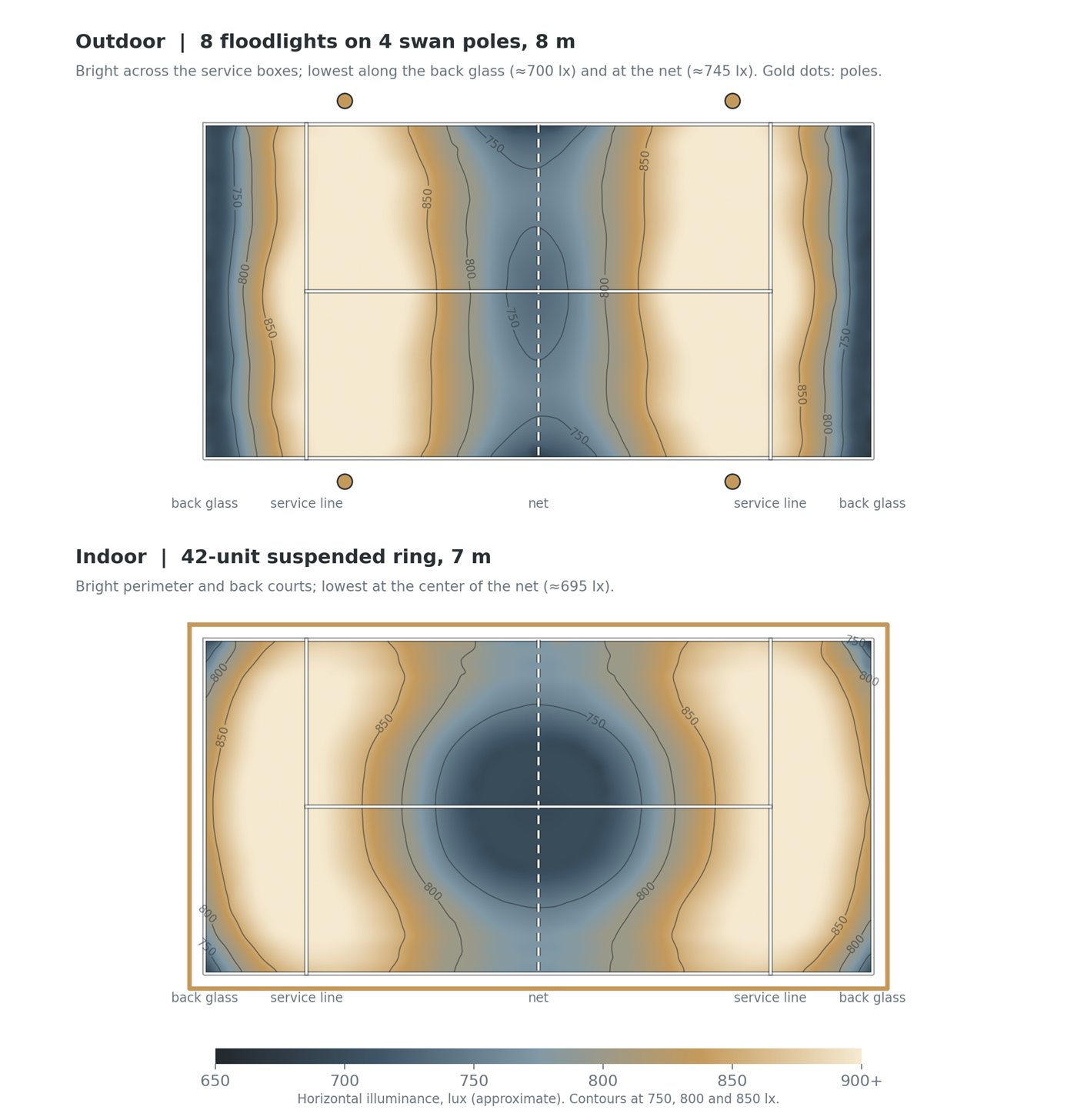
- Brightest across the service boxes; lowest along the back glass (≈700 lx) and at the net (≈745 lx)
Indoor — suspended ring, 7 m
- 11% above the indoor competition level of 750 lx
- Lower glare of the two: peak rating 16 against 21
- Brightest in the back courts, with no pole hot spots
- Lowest at the center of the net (≈695 lx)
- At IP20 it belongs in fully enclosed halls; covered courts with open sides need IP65-rated fixtures
The court next door
On a multi-court site, the glare players complain about most usually isn't from their own court's lights. It comes from the floodlights of the neighboring courts, aimed across those courts and toward yours. Section 03 shows why it happens and how to design it out.
01 Where the light lands
Two systems, opposite patterns
Seen from directly above, on one color scale, the outdoor and indoor studies put their light in opposite places. Darker areas receive less light; the palest areas receive 900 lux or more.
Outdoor
The four swan poles stand along the sides, about 4.2 m in from each end. Their light forms two bright bands across the service boxes, 3–6 m from each back wall, where much of the surface reads 900 lx or more. Between the bands the level eases to about 745 lx at the net; beyond them it eases to about 700 lx along the back glass, the lowest point on the court.
Indoor
The ring hangs just outside the enclosure, so it washes the perimeter first. The back courts are the brightest zones, mostly above 850 lx. Light fades toward the middle of the court and reaches its lowest level, about 695 lx, at the center of the net. The four corners dip slightly, to around 730–740 lx.
03 The court next door
Glare from the court next door
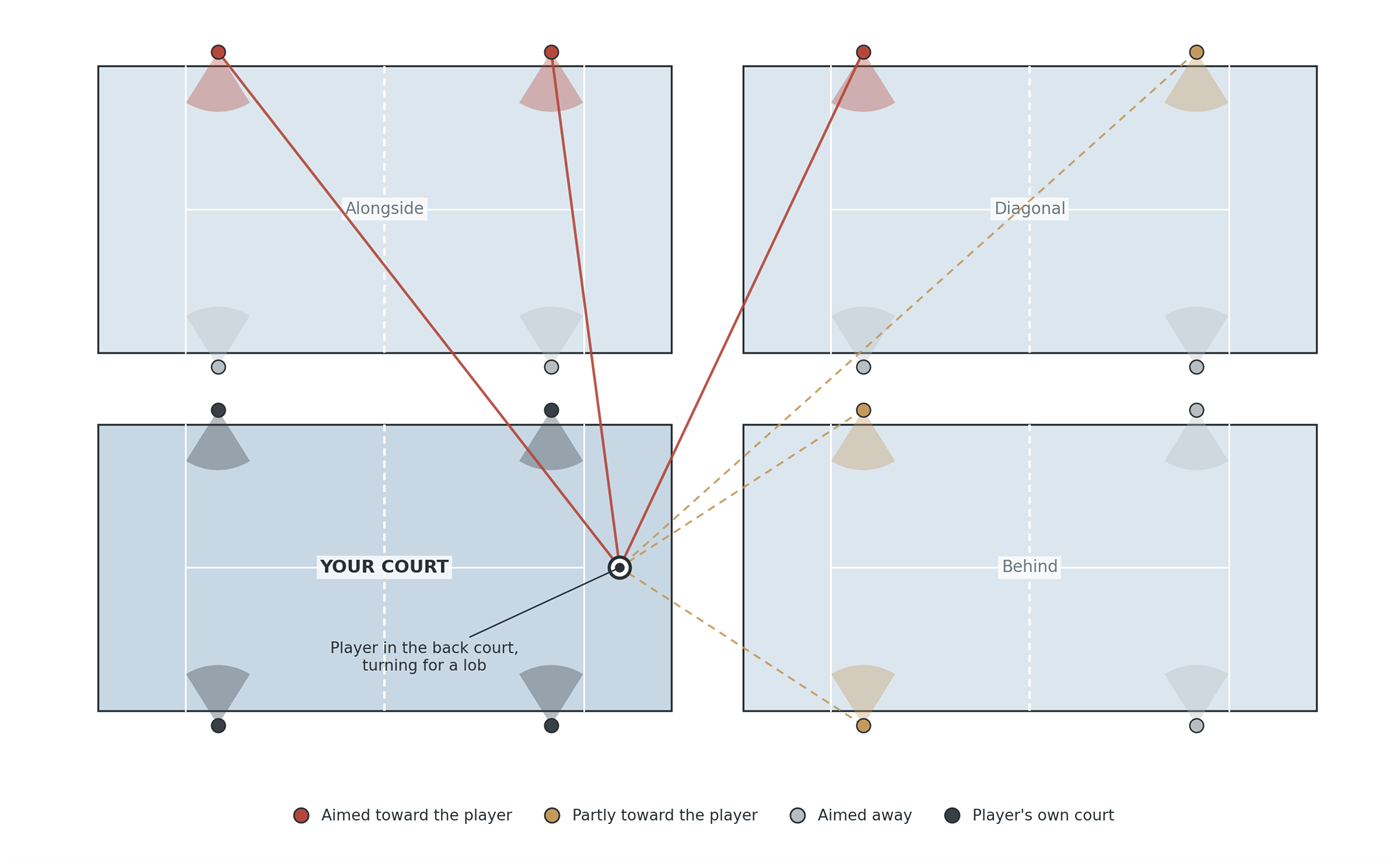
Court lighting studies, including the two in this analysis, are calculated for one court on its own. At a multi-court club, the floodlights of neighboring courts are aimed across their own court and often straight toward yours. It is the lighting complaint we hear most from clubs, by a wide margin: players lose the ball against a neighbor's floodlight as they look up for a lob or turn to chase one.
Lights aimed across the next court
The far-side poles of the court alongside, and of the court diagonally behind, light their own court by pointing across it, which points them at yours. From the back court they sit about 15–20° above the horizon: low in the sky, where a lob starts and finishes.
Lights on the court behind
When courts sit end to end, the nearest poles of the court behind are only about 10 m from a player at the back glass, around 30° above the horizon and seen at a steep angle. Players look straight at them every time they turn and run back for a lob.
Why the neighbor's light reaches your players
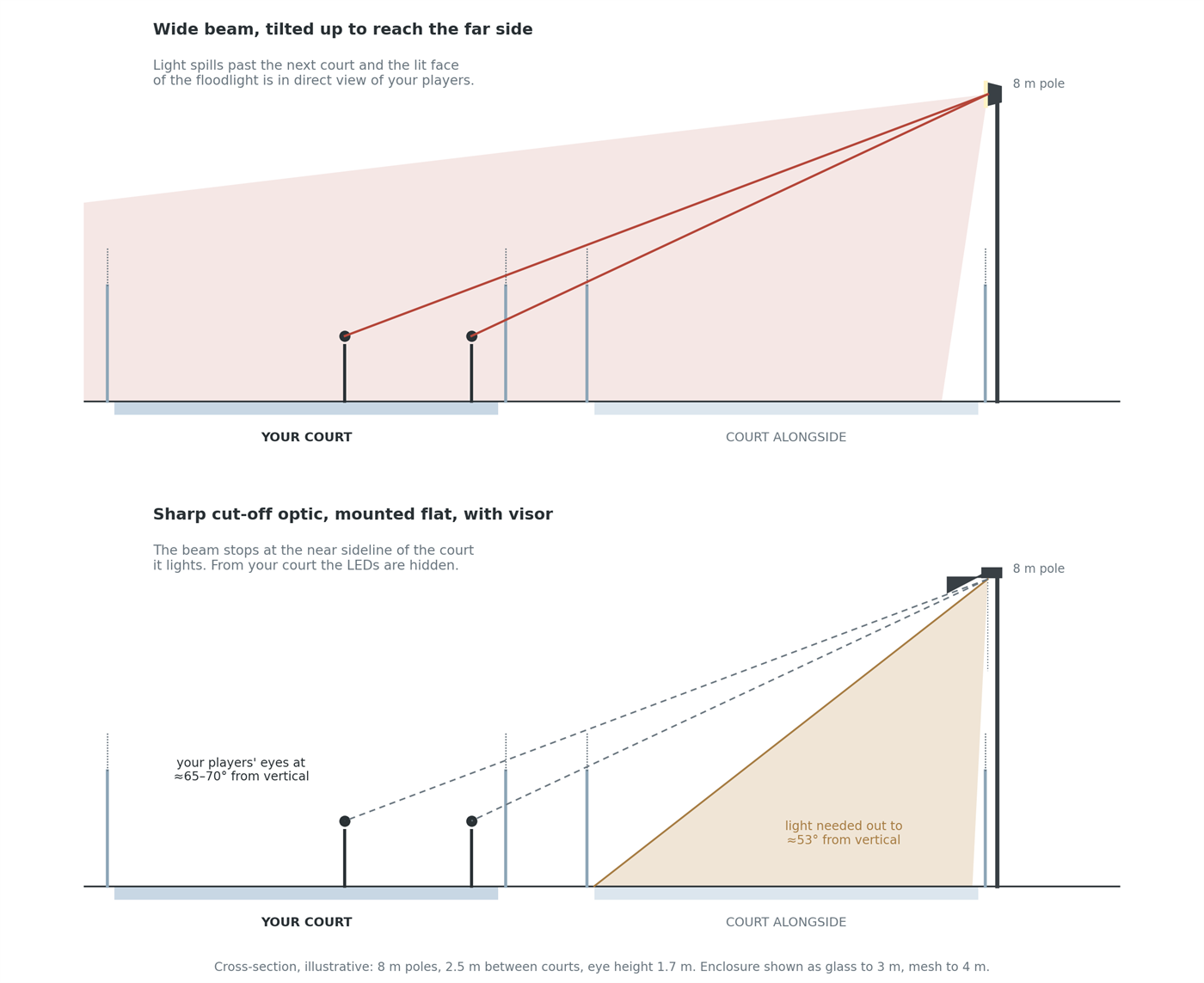
A floodlight on the far side of the next court has to throw light all the way to that court's near sideline, the one closest to you. Your players stand only a few meters beyond it. With 8 m poles, the light must reach about 53° from vertical to cover the neighboring court, while your players' eyes sit at about 65–70°. That narrow band is the whole margin between a well-lit neighbor and a floodlight shining into your players' eyes, and it is why the choice of optic, aiming and shielding matters so much on a multi-court site.
Why padel makes it worse
Players spend much of every rally looking up for lobs, bandejas and smashes, and turning toward the back glass. Panoramic glass adds reflections: bright sources behind a player can appear in the glass they are watching.
Why single-court studies miss it
The glare rating in a court lighting study is calculated from positions on that court, counting that court's own luminaires. The glare players notice most at a multi-court club comes from luminaires outside the calculation. A site-wide study, with every court lit, shows it before installation.
03 The court next door — solutions
Designing it out
Glare from neighboring courts is predictable, which means it can be designed out on a new site and brought under control on an existing one.
For a new club
Light the club, not the court. Commission one site-wide photometric study with every court lit, and check glare from playing positions on every court, looking toward each neighbor as well as along the court.
Specify sharp cut-off optics. Asymmetric sports optics designed to be mounted flat or at a low tilt put light across the court and stop at its far sideline. Wide-beam floodlights tilted up to reach the far side are the main source of neighbor glare.
Fit visors and rear shields. A front visor hides the LED face from anyone beyond the court being lit; a rear shield stops back-spill toward the court behind the pole. Both are widely available as bolt-on accessories.
Consider perimeter lighting. Linear fixtures mounted on each court's own structure, aimed down and inward, keep every light source above its own court; neighboring players see only the back of the housing. The Alta indoor ring works on this principle. Outdoors, specify a system rated IP65 or better.
Rule of thumb
If a player can see the lit face of a neighboring court's floodlight from anywhere on their own court, that fixture needs a visor, a lower tilt or a sharper optic.
Talk to us about your site
Tell us how many courts you are planning and how they sit on the site. We'll help you set the lighting class, pole positions and glare control for the whole club, not just a single court.
Padel elevated
Light the club, not just the court.
Alta Padel delivers premium padel infrastructure: tournament-grade engineering, built to last, and lit to play well on every court.
Sales & projects
Photometric data: Court Technical & Spec Pack, AP-SPEC-2026, Rev A. Lighting classes: EN 12193, Light and lighting — Sports lighting. Zone values and area shares are approximate, read from the photometric study plots. Multi-court geometry is illustrative and based on standard Alta pole positions; site-specific designs will vary.